Stage 1 · The first rains
A stain. A drip.
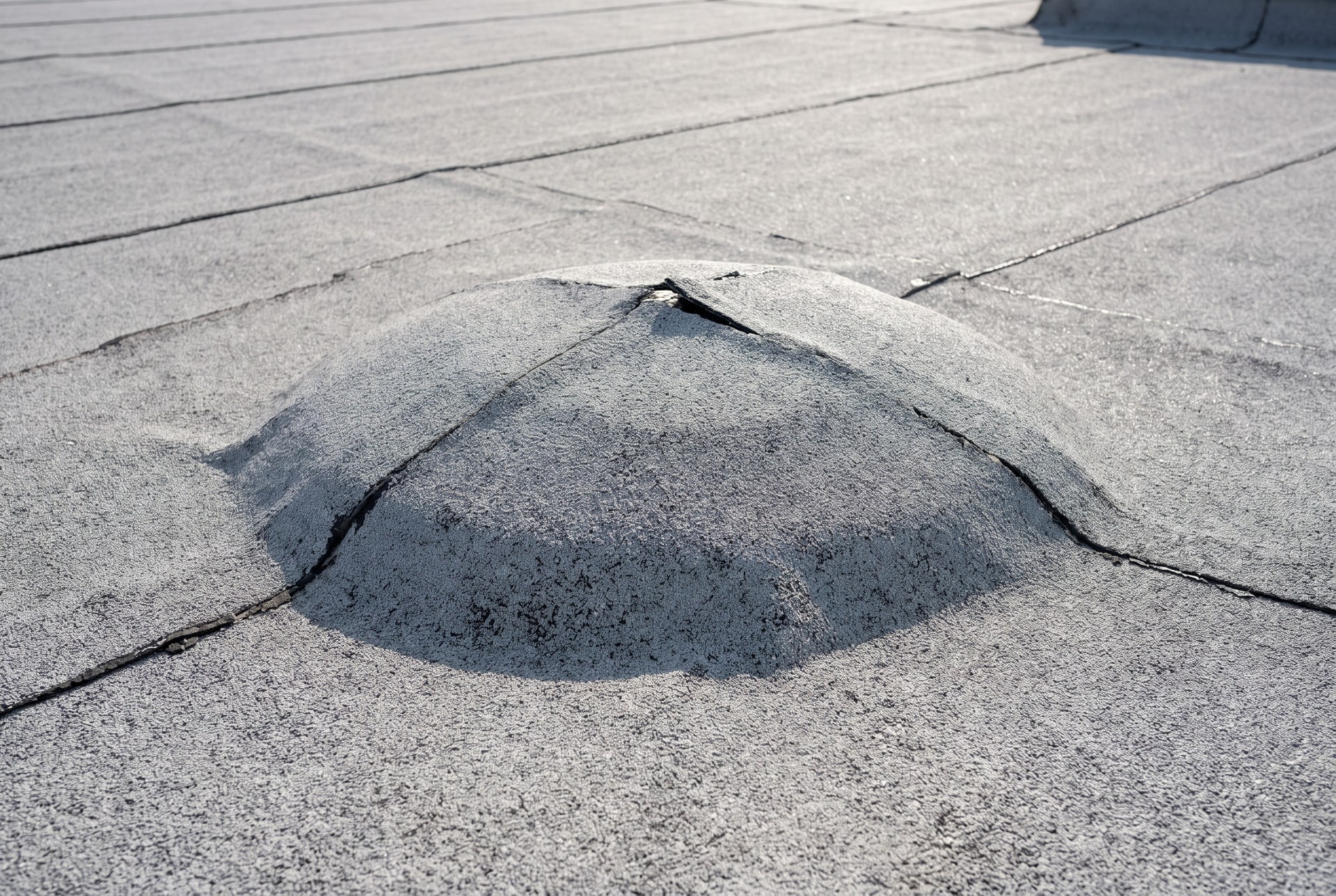
A detail fails. Here it is a rubber pipe boot that has gone brittle in the sun and split around the stack, which is one of the most common entry points on a Kelowna roof. It could as easily be an open lap on a flat roof, a lifted piece of counterflashing or a shingle whose seal strip let go in a wind.
Water gets in at that detail, runs down the underside of the deck, drops onto the insulation and finds the first way through the ceiling, usually a light fitting or a drywall seam. The stain appears a long way from the roof problem. Between rains, most of it dries out.
To put right at this stageOne repair visit.Trace the entry point, replace the boot, check the courses around it. The stain gets painted.
Stage 2 · Weeks to months
The deck stops drying out.
Each rain adds more than the last one took away. The plywood or OSB under the entry point stays damp, then wet. It swells, its layers start to separate, and the nails through it lose some of their grip. The stain on the ceiling stops fading between rains and starts growing instead.
From inside nothing much looks different. From the attic, the underside of the deck has a dark patch that follows the rafter downhill, and the insulation under it is matted.
To put right at this stageThe repair, plus a drywall patch.Same roof repair, but the ceiling now needs cutting out and patching, and the deck gets checked for soft spots before the detail is closed up.
Stage 3 · A season
Insulation soaks. Mould grows.
Attic insulation holds water like a sponge and dries out slowly, if at all. Wet insulation does not insulate, so the room under it runs colder in winter and hotter in summer, and the heating bill quietly goes up. Wet cellulose and batt also grow what damp organic material grows, and an attic breathes into the house below it.
The drywall under the wettest patch is now holding water. It sags. Sooner or later it lets go, usually at night, usually onto something.
To put right at this stageRepair, new insulation, remediation.The roof repair is the smallest line on the invoice. Removing and replacing saturated insulation and dealing with mould are the rest, and they are not roofing trades.
Stage 4 · A year or more
Rot. Then the wind finds it.
Wet sheathing delaminates and goes soft. Fasteners through soft sheathing do not hold, so the next hard blow off the lake takes shingles that were otherwise fine, and now the roof leaks in two places. The top of the rafter under the wet deck starts to rot where it has been sitting in water for a year.
The repair is no longer a detail. It is cutting out a section of deck back to sound wood, sistering or replacing rafter ends, and re-roofing that area so it ties into the rest.
To put right at this stageNew deck section, often a re-roof.Once the deck is going in more than one place, patching stops making sense and the honest answer is usually a new roof. That work goes to Premium Roofing.
Stage 5 · Beyond
Structure and the rooms below.
Left long enough, a leak stops being a roofing problem. Rafters and top plates rot, ceilings come down, water tracks inside wall cavities and into flooring. Electrical fixtures that have been wet for a year are a hazard. Insurers, when they look at a claim like this, look for how long it was known about.
What started as a service call is now a re-roof plus a renovation, plus a remediation, plus time. Nobody plans to get here. It is where roofs get to one missed autumn at a time.
To put right at this stageRe-roof, structural repair, interior rebuild.Several trades and several weeks. The roof is the part we can fix. The rest is the cost of waiting.